
Berkshire · South East
Roof Soft Washing in Berkshire
If moss, lichen or algae is taking over your roof in Berkshire, our roof soft washing service puts it right, with photos sent when we finish.
Berkshire guide price: £450–£780 typical 3-bed semi
Roofs in Berkshire
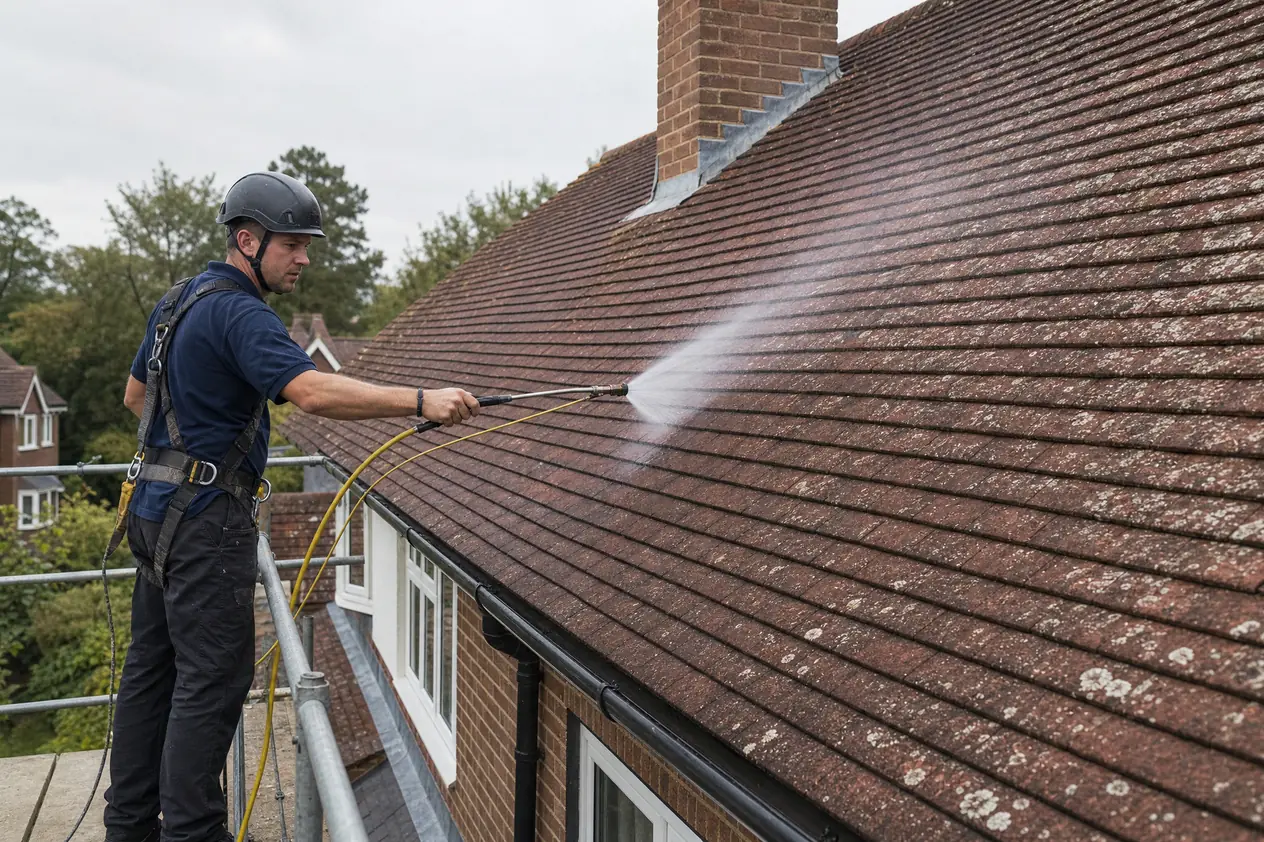
Roofs around Berkshire deal with moderate rainfall, with mature gardens and woodland edges throwing shade and leaf litter onto roofs. Typical properties here include 1930s–1970s semis in concrete interlocking tile, older cottages in Kent peg and plain clay tile, and each needs a slightly different approach.
Soft washing uses the treatment to do the work rather than pressure. We apply the solution with a low-pressure fan spray, let it dwell, and rinse where needed. Lichen and black algae keep fading over the next few weeks as the weather finishes the job.
What's included
- Photo report on completion
- Gentle rinse where needed
- Gutters and downpipes checked and cleared
- Surface moss removed by hand first
- Dwell time to let the treatment work
- Low-pressure application of biocide solution
Get a fixed price in Berkshire
Book a free survey and we'll confirm a fixed price for your Berkshire property in writing.
Questions we're often asked
Are you insured?
Yes. Our teams carry public liability insurance and work to safe working-at-height practice, with scaffold or roof ladders as the roof requires.
Do I need scaffolding?
Many roofs can be reached safely with roof ladders and edge protection. Taller or steeper roofs may need a scaffold, which we'll include in the quote if needed.
Do you cover Berkshire?
Yes. We work throughout Berkshire and the rest of South East, including RG1, SL1, RG12 postcodes. Surveys are free and there's no obligation.
How soon can you start in Berkshire?
Surveys in South East are usually booked within a week, and most jobs are scheduled within two to three weeks, weather permitting.
Is soft washing better than pressure washing?
For most UK roofs, yes. It doesn't strip the tile surface or force water under the laps, and it lasts longer because the treatment kills the growth at the root.